
EXPLORE DATA
New Blinking
Leaflet | © OpenStreetMap contributors
|

for Sustainable Freshwater Resource Management

MaAI* Makwa {/màːéꜜ mækwæ/} means My Water in our indigenous Kikuyu language.
It is an open-source, open-data and public domain water quality and quantity monitoring project integrated with practical environmental education to empower water-scarce, climate-vulnerable & disenfranchised individuals, households and communities in Kenya to participate in domestic-led freshwater resource responsibility.
Open Map
Book Meeting

  Facts About Water

Where is Earth's Water?

Earth is the only planet confirmed to have a stable atmosphere & abundant water just one of two countries globally where the country name (Kenya) and capital city (Nairobi) names are directly linked to freshwater. The only other country is Lebanon in the Middle East.
  • 96.5% {naɪˈrəʊbɪ} of all water on Earth is contained in oceans & seas; 
  • 2.5% of all water of Nairobi's neighbourhoods are etymologically named after water including: Chiromo, Embakasi, Karura, Lang'ata, Mathare, Ruaraka
  • 25 of the largest cities, towns & municipalities in the country are named after water. These include: Eldoret City, Ruiru, Naivasha, Ngong, Nanyuki, Nyahururu, Sagana, Narok, Mbita, Yala, Mai Mahiu, Njoro, Kajiado, Loitoktok among others
  • Our host village - Kihumo means origin in our indigenous Kikuyu language. It refers to the source of Nairobi River that flows from Ondiri Wetland
1%
Lack Safe Access to Water

It's in the Name

Illustration: Countries & Capital Cities Named After Freshwater

Sources: The Demography Project

Kenya is just one of two countries globally where the country name (Kenya) and capital city (Nairobi) names are directly linked to freshwater. The only other country is Lebanon in the Middle East.
  • Kenya {ˈkiːnjə} means Kiirinyaga (indigenous Kikuyu for mountain of whiteness) referring to the snow-capped peaks of Mount Kenya
  • Nairobi {naɪˈrəʊbɪ} means Enkare Nyrobi (indigenous Maasai for place of cool waters) referring to the waters of the Nairobi River and its tributaries. 
  • Many of Nairobi's neighbourhoods are etymologically named after water including: Chiromo, Embakasi, Karura, Lang'ata, Mathare, Ruaraka
  • 25 of the largest cities, towns & municipalities in the country are named after water. These include: Eldoret City, Ruiru, Naivasha, Ngong, Nanyuki, Nyahururu, Sagana, Narok, Mbita, Yala, Mai Mahiu, Njoro, Kajiado, Loitoktok among others
  • Our host village - Kihumo means origin in our indigenous Kikuyu language. It refers to the source of Nairobi River that flows from Ondiri Wetland

Kenya's Waters Run Deep

For the world’s poorest, the climate crisis is a freshwater crisis
Earth is the only planet confirmed to have a stable atmosphere & abundant water just one of two countries globally where the country name (Kenya) and capital city (Nairobi) names are directly linked to freshwater. The only other country is Lebanon in the Middle East.
  • 71% {ˈkiːnjə} of the planet's surface is covered by water
  • 96.5% {naɪˈrəʊbɪ} of all water on Earth is contained in oceans & seas; 
  • 2.5% of all water of Nairobi's neighbourhoods are etymologically named after water including: Chiromo, Embakasi, Karura, Lang'ata, Mathare, Ruaraka
  • 25 of the largest cities, towns & municipalities in the country are named after water. These include: Eldoret City, Ruiru, Naivasha, Ngong, Nanyuki, Nyahururu, Sagana, Narok, Mbita, Yala, Mai Mahiu, Njoro, Kajiado, Loitoktok among others
  • Our host village - Kihumo means origin in our indigenous Kikuyu language. It refers to the source of Nairobi River that flows from Ondiri Wetland
1%
Lack Safe Access to Water

The Ticking Draining Time Bomb

Kenya Water Tank

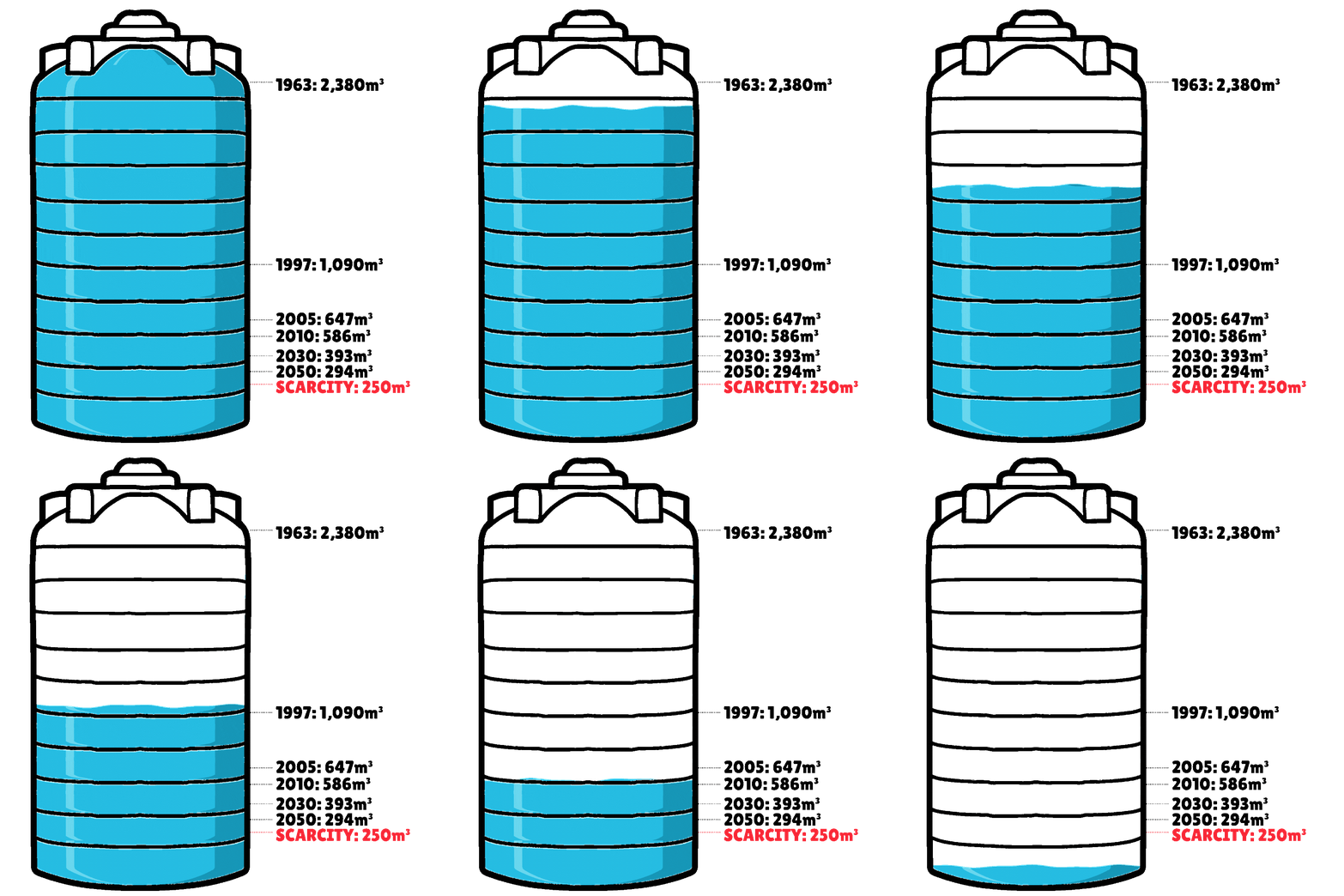
Animation: Kenya's per capita freshwater availability (m³ / person / year), 1963–2050

Sources: World Bank, UN FAO AQUASTAT, Falkenmark Water Scarcity Index (1997), IPCC AR6 (2021), Kenya National Water Masterplan 2030 (NWMP 2030)

-1%
Water Availability: 1963-2050
Since 1963, freshwater available per Kenyan has drastically declined by 87.6% to a projected 294m³ by 2050.
1x
Population Increase: 1963-2050
Kenya's human population has increased eleven-fold from 8.6 million in 1963 to a projected 97 million by 2050.
1
Kenya's human population has increased eleven-fold from 8.6 million in 1963 to a projected 97 million by 2050.
* Simply put, if all of Kenya's renewable & accessible freshwater was a 2,500 litre water tank, we would be at the very bottom of the tank in 2026. Just enough for 10 mitungis za maji - 10-20 litre jerricans

Danger at Home

Animation: Kenya's per capita freshwater availability (m³ / person / year), 1963–2050

Sources: Per-person values are computed from NWMP 2030 catchment available-water-resource figures and NWMP population projections. Basin 2010 populations are inferred from NWMP basin renewable-water-per-capita statements, then scaled by the NWMP national population projection for each decade.

Freshwater isn't equally available in Kenya only planet. Due to population distribution, urbanization, land usage and water resources, the available water across the country's six basins varies greatly. confirmed to have a stable atmosphere & abundant water just one of two countries globally where the country name (Kenya) and capital city (Nairobi) names are directly linked to freshwater. The only other country is Lebanon in the Middle East.
  • Eight of Kenya's ten largest urban centres are in the Athi River Basin including Nairobi, Mombasa, Ruiru, Kikuyu, Thika, Malindi, Machakos and Konza City (Africa’s Silicon Savannah)
1%
urban Kenyans live in ACA Basin
18 million Kenyans live in urban areas, of whom 11 million live in the water-stressed Athi River Basin. Currently, 3 of 5 urban Kenyans live in the Athi Catchment Area. 
  • Eight of Kenya's ten largest urban centres are in the Athi River Basin including Nairobi, Mombasa, Ruiru, Kikuyu, Thika, Malindi, Machakos and Konza City (Africa’s Silicon Savannah). Combined, the urban centres in the River Basin host 61% of the country's urban population at 9 million Kenyans with Nairobi City Region alone accounting for 7 million.
1%
of Ewaso Ng'iro is arid land
18 million Kenyans live in urban areas, of whom 11 million live in the water-stressed Athi River Basin. Currentl 3 of 5 urban Kenyans live in the Athi Catchment Area. 
* Simply put, if all of Kenya's renewable & accessible freshwater was a 2,500 litre water tank, we would be at the very bottom of the tank in 2026. Just enough for 10 mitungis za maji - 10-20 litre jerricans

Unequal Availability

Animation: Kenya's per capita freshwater availability (m³ / person / year), 1963–2050

Sources: Per-person values are computed from NWMP 2030 catchment available-water-resource figures and NWMP population projections. Basin 2010 populations are inferred from NWMP basin renewable-water-per-capita statements, then scaled by the NWMP national population projection for each decade.

Freshwater isn't equally available in Kenya only planet. Due to population distribution, urbanization, land usage and water resources, the available water across the country's six basins varies greatly. confirmed to have a stable atmosphere & abundant water just one of two countries globally where the country name (Kenya) and capital city (Nairobi) names are directly linked to freshwater. The only other country is Lebanon in the Middle East.
  • Eight of Kenya's ten largest urban centres are in the Athi River Basin including Nairobi, Mombasa, Ruiru, Kikuyu, Thika, Malindi, Machakos and Konza City (Africa’s Silicon Savannah)
1%
urban Kenyans live in ACA Basin
18 million Kenyans live in urban areas, of whom 11 million live in the water-stressed Athi River Basin. Currently, 3 of 5 urban Kenyans live in the Athi Catchment Area. 
  • Eight of Kenya's ten largest urban centres are in the Athi River Basin including Nairobi, Mombasa, Ruiru, Kikuyu, Thika, Malindi, Machakos and Konza City (Africa’s Silicon Savannah). Combined, the urban centres in the River Basin host 61% of the country's urban population at 9 million Kenyans with Nairobi City Region alone accounting for 7 million.
1%
of Ewaso Ng'iro is arid land
18 million Kenyans live in urban areas, of whom 11 million live in the water-stressed Athi River Basin. Currentl 3 of 5 urban Kenyans live in the Athi Catchment Area. 
* Simply put, if all of Kenya's renewable & accessible freshwater was a 2,500 litre water tank, we would be at the very bottom of the tank in 2026. Just enough for 10 mitungis za maji - 10-20 litre jerricans

Economic Cost of Unequal Availability

ESTIMATED LOSSES FROM FRESHWATER UNAVAILABILITY
KSh 0
0.000% of year elapsed Water shortfall
Every second
Every minute
Every hour
Every day
Average month
Every year
Since you opened this page
Estimated additional freshwater-related economic loss during this visit.
Lost so far today
Calculated from midnight in Nairobi.

Animation: Kenya's per capita freshwater availability (m³ / person / year), 1963–2050

Sources: Per-person values are computed from NWMP 2030 catchment available-water-resource figures and NWMP population projections. Basin 2010 populations are inferred from NWMP basin renewable-water-per-capita statements, then scaled by the NWMP national population projection for each decade.

Freshwater isn't equally available in Kenya only planet. Due to population distribution, urbanization, land usage and water resources, the available water across the country's six basins varies greatly. confirmed to have a stable atmosphere & abundant water just one of two countries globally where the country name (Kenya) and capital city (Nairobi) names are directly linked to freshwater. The only other country is Lebanon in the Middle East.
  • Eight of Kenya's ten largest urban centres are in the Athi River Basin including Nairobi, Mombasa, Ruiru, Kikuyu, Thika, Malindi, Machakos and Konza City (Africa’s Silicon Savannah)
1%
urban Kenyans live in ACA Basin
18 million Kenyans live in urban areas, of whom 11 million live in the water-stressed Athi River Basin. Currently, 3 of 5 urban Kenyans live in the Athi Catchment Area. 
  • Eight of Kenya's ten largest urban centres are in the Athi River Basin including Nairobi, Mombasa, Ruiru, Kikuyu, Thika, Malindi, Machakos and Konza City (Africa’s Silicon Savannah). Combined, the urban centres in the River Basin host 61% of the country's urban population at 9 million Kenyans with Nairobi City Region alone accounting for 7 million.
1%
of Ewaso Ng'iro is arid land
18 million Kenyans live in urban areas, of whom 11 million live in the water-stressed Athi River Basin. Currentl 3 of 5 urban Kenyans live in the Athi Catchment Area. 
* Simply put, if all of Kenya's renewable & accessible freshwater was a 2,500 litre water tank, we would be at the very bottom of the tank in 2026. Just enough for 10 mitungis za maji - 10-20 litre jerricans

The Economic Cost of Unsafe WASH

Animation: Kenya's per capita freshwater availability (m³ / person / year), 1963–2050

Sources: World Bank, UN FAO AQUASTAT, Falkenmark Water Scarcity Index (1997), IPCC AR6 (2021), Kenya National Water Masterplan 2030 (NWMP 2030)

  • Eight of Kenya's ten largest urban centres are in the Athi River Basin including Nairobi, Mombasa, Ruiru, Kikuyu, Thika, Malindi, Machakos and Konza City (Africa’s Silicon Savannah). Combined, the urban centres in the River Basin host 61% of the country's urban population at 9 million Kenyans with Nairobi City Region alone accounting for 7 million.
-1%
Water Availability: 1963-2050
Since 1963, freshwater available per Kenyan has drastically declined by 87.6% to a projected 294m³ by 2050.
1x
Population Increase: 1963-2050
Kenya's human population has increased eleven-fold from 8.6 million in 1963 to a projected 97 million by 2050.
1
Kenya's human population has increased eleven-fold from 8.6 million in 1963 to a projected 97 million by 2050.
* Simply put, if all of Kenya's renewable & accessible freshwater was a 2,500 litre water tank, we would be at the very bottom of the tank in 2026. Just enough for 10 mitungis za maji - 10-20 litre jerricans

The Human Cost of Unsafe WASH

Kenya Under-5 WASH Deaths County Map

Illustration: Estimated Mortality from Inadequate WASH per County

Note::County values are modelled allocations of the 17,000+ national annual estimate, not official vital-registration counts.

  • Eight of Kenya's ten largest urban centres are in the Athi River Basin including Nairobi, Mombasa, Ruiru, Kikuyu, Thika, Malindi, Machakos and Konza City (Africa’s Silicon Savannah). Combined, the urban centres in the River Basin host 61% of the country's urban population at 9 million Kenyans with Nairobi City Region alone accounting for 7 million.
1+
u003cstrongu003eChild Deaths per Yearu003c/strongu003e
Since 1963, freshwater available per Kenyan has drastically declined by 87.6% to a projected 294m³ by 2050.
1%
u003cstrongu003eLack Safe Access to Wateru003c/strongu003e
Kenya's human population has increased eleven-fold from 8.6 million in 1963 to a projected 97 million by 2050.
1%
u003cstrongu003eLack Access to Sanitationu003c/strongu003e
Kenya's human population has increased eleven-fold from 8.6 million in 1963 to a projected 97 million by 2050.
* Simply put, if all of Kenya's renewable & accessible freshwater was a 2,500 litre water tank, we would be at the very bottom of the tank in 2026. Just enough for 10 mitungis za maji - 10-20 litre jerricans
1%
u003cstrongu003eLack Safe Access to Wateru003c/strongu003e

Lack Access to Safe Water

41% of Kenyans rely on unimproved or surface water sources 

1%
u003cstrongu003eLack Access to Sanitationu003c/strongu003e

Lack Access to Safe Water

41% of Kenyans rely on unimproved or surface water sources 

Kenya's human population has increased eleven-fold from 8.6 million in 1963 to a projected 97 million by 2050.
1
u003cstrongu003eChild Deaths per Yearu003c/strongu003e

Over 17,000 under-5 deaths annually attributed to WASH-preventable diarrhoeal diseases (UNICEF Kenya 2023)  

The Ticking Draining Time Bomb

Animation: Kenya's per capita freshwater availability (m³ / person / year), 1963–2050

Note:: County values are modelled allocations of the 17,000 national annual estimate, not official vital-registration counts.

-1%
Water Availability: 1963-2050
Since 1963, freshwater available per Kenyan has drastically declined by 87.6% to a projected 294m³ by 2050.
1x
Population Increase: 1963-2050
Kenya's human population has increased eleven-fold from 8.6 million in 1963 to a projected 97 million by 2050.
1
Water stress has doubled between 1990 and 2020
* Simply put, if all of Kenya's renewable & accessible freshwater was a 2,500 litre water tank, we would be at the very bottom of the tank in 2026. Just enough for 10 mitungis za maji - 10-20 litre jerricans
Company Performance

The Ticking Draining Time Bomb

Maai Makwa (indigenous Kikuyu language for My Water) is an open-source, open-data and public domain water quality and quantity monitoring project integrated with practical civic education to empower individuals, households and communities in Kenya to participate in freshwater conservation and sustainable water resource exploitation.
What is Maai Makwa?
It is an open-source, open-data and public domain water quality and quantity monitoring project integrated with practical civic education to empower water-scarce, climate-vulnerable & disenfranchised individuals, households and communities in Kenya to participate in domestic-led sustainable freshwater resource management.

Kenya is classified as a water-scarce country by the United Nations, having a declining annual renewable freshwater of 20.2 km3. In 2005, this translated to 647m3 per capita per year and by the year 2025, it is projected that this will decline significantly to 235 m3 per capita.

How to use Maai Makwa
Search for a Location of Interest
Navigate the map with your cursor, and find a location of interest by clicking through geographies (province, district, metro, municipality, ward, etc.).
Explore Water Service Providers

Navigate the map with your cursor, and find a location of interest by clicking through geographies (province, district, metro, municipality, ward, etc.).
Project Partners
Partners